Choosing
How to choose a timber fence
There is no single best timber fence. There is a best fence for your boundary, and the honest way to get to it is to work through what the fence actually has to do.
6 min read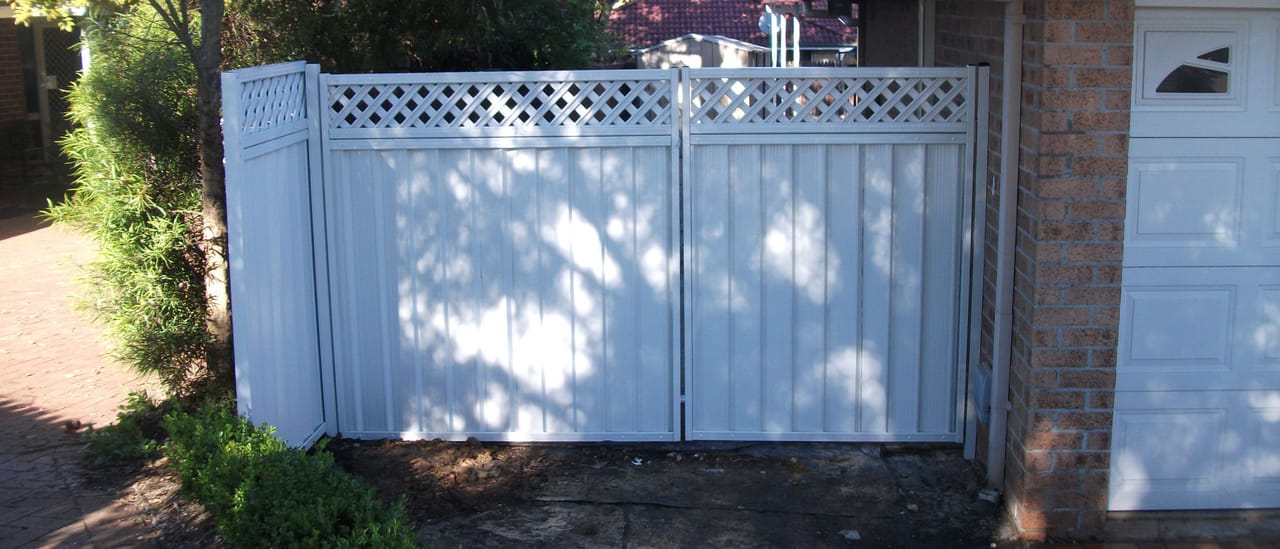
Gates are the part of a fence that moves, which makes them the part most likely to give you trouble. They are also the part people specify last, when the decision has already been constrained by everything else.
Worth thinking about early.
Not what the gate should be called. What has to pass through the opening.
| What has to get through | Gate that usually suits |
|---|---|
| A person | Pedestrian gate, one leaf |
| A mower, bin or wheelbarrow | Single gate, one wider leaf |
| A trailer or wide equipment | Double gate, two leaves |
| A vehicle | Driveway gate, usually a pair of leaves |
One long gate leaf is heavy, and all of that weight hangs off hinges on one side. Over time a leaf that is too wide for its hardware drops, drags on the ground and stops latching.
Splitting the opening into two leaves halves the width each set of hinges carries, and each leaf needs far less room to swing. On a driveway, where there is often a wall or a parked car close by, that clearance matters as much as the weight does.
A gate is not just a section of fence on hinges. These are the factors that actually drive it:
This is where gates fail. A gate post carries a swinging load that changes every time the gate is used, and it carries it as leverage rather than straight down.
So gate posts are sized and set for that load rather than treated as ordinary posts in the run. 65mm x 65mm steel posts are commonly used for gate positions for exactly this reason. Like all posts they go 600mm deep with at least one full 20kg bag of concrete, and they can be filled with concrete up to a third of their length.
A gate built from the same palings, to the same height and the same top line, reads as part of the boundary. A gate that does not match reads as a gate.
On a lap & cap fence this matters most, because the capping line is the strongest visual line in the fence. Carrying it across the gate and through the opening is what makes the run look continuous.
Gates can be built to match single paling, lap & cap, lapped only and hardwood single paling fencing.
Hardware is chosen for the size and weight of the leaf rather than picked off a shelf.
If a gate forms part of a swimming pool barrier, it is regulated. How it has to behave, including its hardware and the direction it opens, is set by the requirements that apply to your property.
Those requirements are established before the gate is built, and compliance of a pool barrier is certified by your council or an accredited certifier rather than by us. We do not publish generic pool gate rules, because a generic answer can be wrong for your property.
Lattice and decorative top panels can be built into timber gates, particularly driveway gates, and painted finishes are common on gates even where the fence is left uncoated.
It is one of the few places on a boundary where a bit of detail reads as considered rather than fussy, because a gate is a defined object rather than a long run.
A single gate uses one leaf across the whole opening. A double gate splits the opening into two leaves that meet in the middle, which suits wider openings because each leaf is lighter and needs less room to swing.
Usually because the leaf is too wide and heavy for its hinges and posts. A gate post carries a swinging load as leverage, so gate posts and hardware are sized for the specific leaf rather than treated as ordinary fence posts.
Yes, where the fence is single paling, lap & cap, lapped or hardwood. Bring a photo of the fence taken from one end looking along it to the site measure.
Automation is a separate consideration to the gate, and it affects how the opening is set out. Raise it at the site measure so the opening is built with it in mind rather than retrofitted.
There is no single best timber fence. There is a best fence for your boundary, and the honest way to get to it is to work through what the fence actually has to do.
6 min readA timber fence looks simple once it is up, which is exactly why a badly built one is so obvious. The line wanders, the top steps unevenly, the posts move within a few years.
6 min readHeight is the specification people are most confident about and most often wrong about, because the number you have in your head is rarely the number that matters on site.
5 min read
Once you know what you want, Jye Fulton will measure the boundary and quote it. There is no charge for the visit.
NSW Fencing Licence 269038C · ABN 76 612 245 594