Choosing
How to choose a timber fence
There is no single best timber fence. There is a best fence for your boundary, and the honest way to get to it is to work through what the fence actually has to do.
6 min read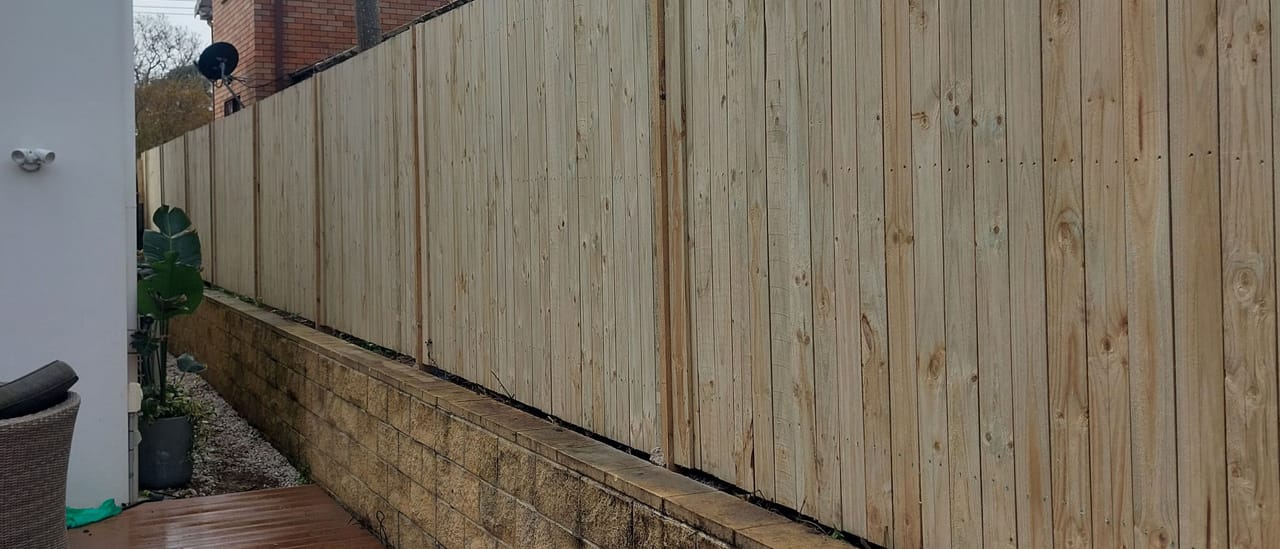
Height is the specification people are most confident about and most often wrong about, because the number you have in your head is rarely the number that matters on site.
What matters is the finished height measured from the ground, on both sides of the fence, on ground that may not be level.
Timber fencing is built up to a maximum height of 2.4m. The heights that come up most often are 1.5m, 1.8m, 2.1m and 2.4m.
| Height | Where it typically gets used |
|---|---|
| 1.5m | Lower boundaries, front and side fencing where full screening is not the aim |
| 1.8m | The usual residential side and rear boundary height |
| 2.1m | Where extra privacy or screening is wanted above standard height |
| 2.4m | The maximum built height, where maximum screening is the objective |
At 1.8m a fence sits above eye level for most adults, which is the point where a boundary fence stops being something you look over and starts being something you look at.
It is also the height most Sydney residential boundary fencing is already built to, which matters when you are replacing one section of a run and want the new work to match what is either side of it.
A fence has two sides, and the ground is often not at the same level on both. A 1.8m fence measured from the high side can be well over 1.8m when you look at it from the low side.
That means the height you actually want depends on which side you are standing on and what you are trying to screen. It is one of the main things worked out at the site measure, standing on the boundary rather than looking at a plan.
On sloping Sydney blocks it is very common for a timber fence to sit on top of an existing retaining wall or block wall.
When it does, the wall height adds to the visual height of the barrier from the low side. A 1.8m fence on a 600mm wall reads as a 2.4m barrier from below, even though the fence itself is 1.8m.
This affects two things: the height you actually want, and how visible the top of the fence becomes. A very visible top line is where a capping rail earns its place.
Where the ground falls along the fence line, the fence either steps down in sections or rakes to follow the ground.
Stepping keeps each section level and creates a series of deliberate steps along the top. Raking follows the slope so the top line runs parallel to the ground.
Which one suits depends on how steep the fall is, what the fence has to screen, and what looks right against the house and the neighbouring fences. It is a site decision.
A taller fence carries more load. It catches more wind, it carries more palings, and it puts more leverage on the posts.
So height is not a standalone choice. It affects rail count, post selection and how the fence is built.
What height you are permitted to build on your property is not something that can be answered accurately in a general guide. It can depend on where the fence sits on the property, what is either side of it, whether the fence forms part of a pool barrier, and the requirements that apply to your property.
If your fence relates to a pool barrier, that is a regulated area, and requirements are confirmed with your council or an accredited certifier rather than assumed.
The practical approach is to raise the height you want at the site measure so any constraint is identified before work is scheduled.
1.8m is the usual height for a residential side or rear boundary. 1.5m, 2.1m and 2.4m are also common depending on what the fence needs to do.
Timber fencing is built up to a maximum height of 2.4m.
The wall adds to the visual height of the barrier from the low side. A 1.8m fence on a 600mm wall reads as a 2.4m barrier from below, which affects both the height you want and how visible the top of the fence becomes.
It can depend on where the fence sits on the property, what is either side of it, whether it forms part of a pool barrier, and the requirements that apply to your property. Raise the height you want at the site measure so any constraint is identified before work is scheduled.
There is no single best timber fence. There is a best fence for your boundary, and the honest way to get to it is to work through what the fence actually has to do.
6 min readA timber fence looks simple once it is up, which is exactly why a badly built one is so obvious. The line wanders, the top steps unevenly, the posts move within a few years.
6 min readWe do not publish per-metre prices, and any timber fencing website that does is quoting a fence it has not seen.
7 min read
Once you know what you want, Jye Fulton will measure the boundary and quote it. There is no charge for the visit.
NSW Fencing Licence 269038C · ABN 76 612 245 594